
Key takeaways
- Two rollers achieved the same compaction specification during an HS2 comparative trial, but the Dynapac CA6000D SEISMIC recorded fuel consumption 20-32% lower during the evaluation period.
- The difference came from adapting vibration frequency to the material being compacted, helping transfer more energy into the ground and reducing unnecessary vibration.
- The trial indicated improved surface density close to the finished layer, with the potential to reduce additional finishing operations on similar applications.
- As contractors look for practical ways to reduce costs and emissions, improving the efficiency of existing equipment will become an increasingly important part of the conversation.
Two 19-tonne rollers both achieved the same degree of compaction for the same material on the same project – but one recorded fuel consumption 20-32% lower. The difference was not simply a question of engine efficiency; it came from how the roller used its vibration energy.
The findings from this comparative trial on a section of HS2 challenges a long-held assumption in earthworks that achieving better compaction performance depends on applying more energy. Instead, they suggest that future efficiency gains may come from using the energy already available more intelligently.
The hidden cost of wasted energy
Compaction rarely attracts much attention when everything goes to plan. If the required density is achieved, the machine moves onto the next section. But every unnecessary pass consumes fuel, every additional hour increases operating costs, and every moment of avoidable vibration contributes to machine wear and operator fatigue. As contractors face growing pressure to improve productivity while reducing carbon emissions and controlling costs, efficiency during compaction deserves closer attention.
Working with the material, not against it.
Every material has a natural resonant frequency – the point at which vibration energy can be transferred most efficiently. The challenge is that this frequency changes continuously as compaction progresses. Conventional rollers typically operate at a fixed vibration frequency, regardless of how the material beneath the drum changes, meaning that some of the energy generated by the machine may not contribute effectively to compaction.
Dynapac’s patented SEISMIC technology takes a different approach by continuously identifying the resonant frequency of the material and adjusting the exciter system to match. The principle is similar to pushing a child on a swing.
“If you push at exactly the right moment, the swing goes higher with very little effort. Push at the wrong moment and you have to work much harder for the same result,” explained Andreas Persson, calculation engineer at Dynapac, who was instrumental in developing the technology
“Soil behaves in much the same way. By continuously identifying the resonant frequency of the soil and matching the vibration to it, the roller transfers more energy into the ground instead of wasting it through unnecessary vibration.”
Demonstrating the technology with strict project requirements
The trial carried out by Balfour Beatty VINCI (BBV), together with SMT GB and Dynapac, during construction of HS2 near Birmingham earlier this year provided a valuable test environment due to its rigorous earthworks standards. The evaluation compared a Dynapac CA6000D SEISMIC roller with a common 19-tonne alternative while compacting 40mm layers of 6F8 subgrade material prepared to project specifications.
Both machines operated on parallel test areas under comparable conditions and operating periods. Density measurements were taken at multiple depths using a nuclear density gauge (NDG), layer stiffness was assessed using a falling weight deflectometer, and fuel consumption was monitored through machine telematics.
The objective was to understand whether adaptive vibration could improve efficiency while maintaining the compaction standards required on a major infrastructure project.
The trial at a glance
Location: HS2 construction near Birmingham
Material tested: 6F8 crushed limestone (0/40mm)
Machines evaluated: Dynapac CA6000D SEISMIC and comparable 19-tonne roller
Key measurements taken: Density, stiffness, and fuel consumption
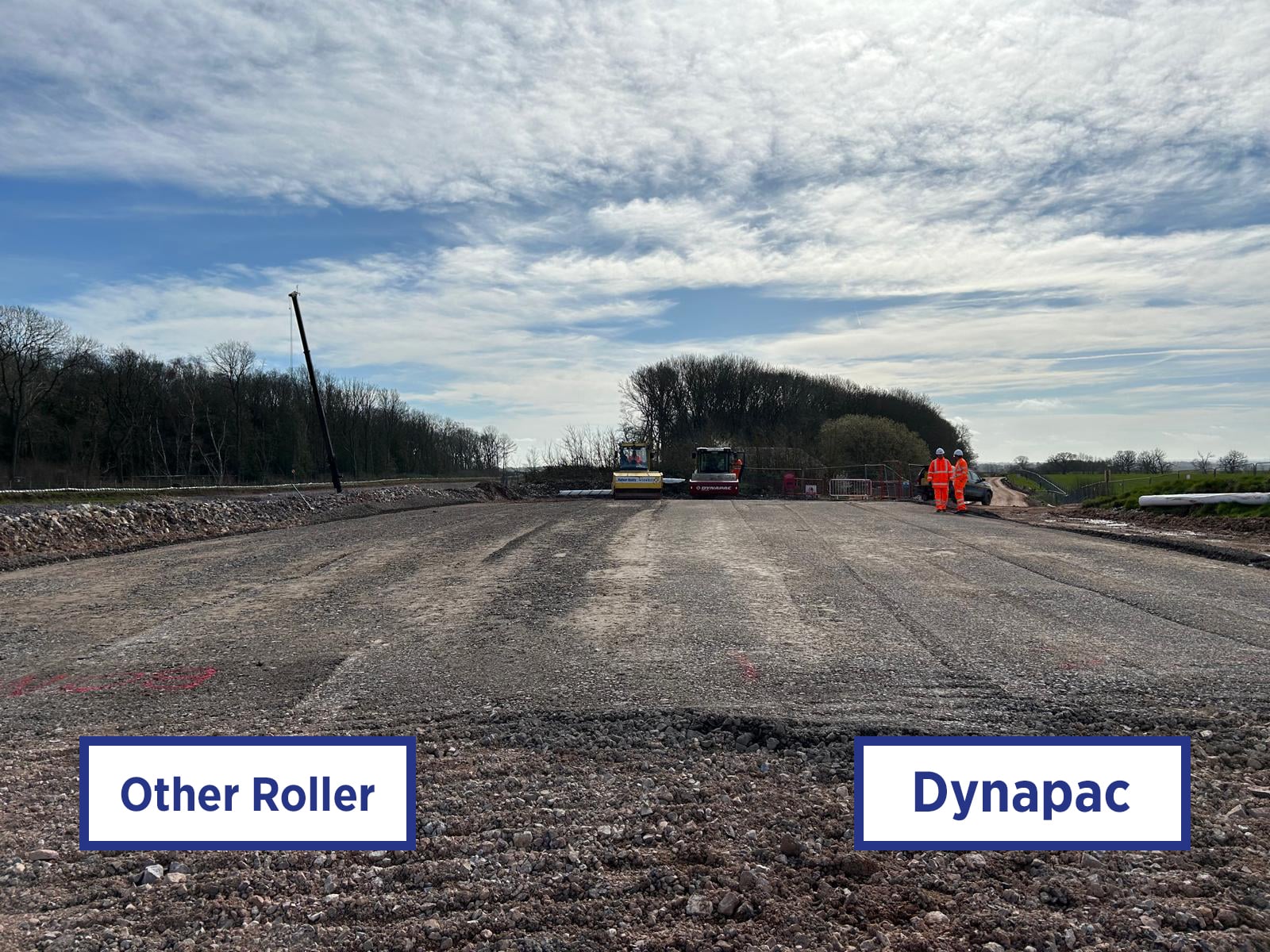
The Dynapac roller produced a significantly smoother finish on the right than the comparable machine did on the left.
Comparable compaction. Different levels of efficiency.
Both machines achieved the required degree of compaction, but the Dynapac roller produced improved density closer to the surface following the finishing passes, reducing surface loosening and improving surface quality. BBV concluded that this level of surface performance could remove the need for the additional pneumatic tyre roller previously used to complement the alternative roller on similar work.
The Dynapac machine also recorded fuel consumption up to approximately 20-32% lower than the other roller. While further testing across different applications would provide additional validation, the results suggest that intelligent vibration control can reduce diesel consumption without compromising compaction performance.
Operators also reported a quieter and more comfortable working experience due to the optimised vibration levels.
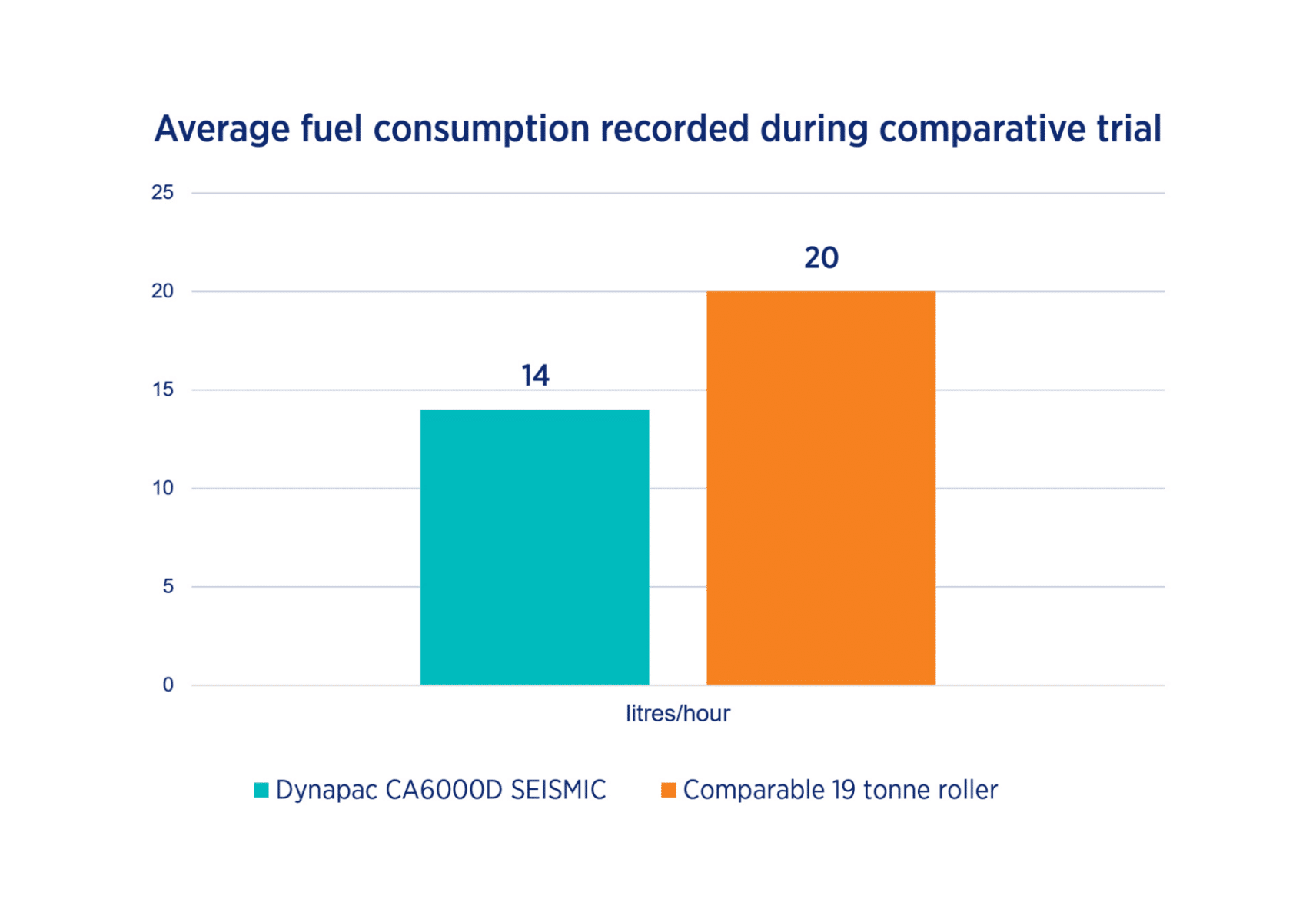
Results recorded during monitored operating periods at the HS2 trial site. Actual performance will vary depending on material, conditions, and operating practices.
“The trial showed the Dynapac roller achieved the required compaction performance while also delivering excellent surface density and fuel efficiency. The optimised vibration levels created a noticeably more comfortable operating experience. Those are all factors worth considering on major infrastructure projects where productivity, fuel consumption, and operator wellbeing all contribute to overall project performance,” said Aurélien Fabre, head of plant at Balfour Beatty VINCI.
Looking beyond fuel savings
The reduction in hourly fuel consumption might appear relatively small when viewed in isolation but across major rail, highway, or other earthworks projects where rollers operate continuously over extended periods, incremental efficiency gains can be significant.
Lower fuel consumption means reduced operating costs and fewer emissions – and if improved surface density reduces additional finishing operations or the need for secondary equipment, the potential benefits extend beyond fuel alone. Decarbonisation in the construction industry is often associated with alternative power sources but improving the efficiency of existing equipment is also essential, especially in applications where machines need to deliver consistent performance in demanding conditions.
Sometimes the most effective way to reduce energy consumption is not to replace the energy source, but to stop wasting energy in the first place.
A new measure of machine performance
For decades, equipment selection has focused heavily on specifications such as weight, power, and amplitude, but contractors are increasingly looking at the bigger picture:
How much fuel does a machine consume over its working life?
How does it affect operating costs?
Can it reduce unnecessary passes?
Can it support environmental targets without compromising performance?
Andy Bullock, general manager of road and compact equipment at Dynapac dealer SMT GB, is witnessing this broader change in how customers evaluate road machinery.
“Customers are rightly focused on productivity, but they also want to understand how equipment can help them reduce operating costs, improve efficiency, and support sustainability objectives,” he said.
“Trials like this are valuable because they provide evidence from real working conditions and show that the construction industry has a genuine opportunity to rethink how it uses energy during one of its most routine processes. The future of compaction is about making every vibration count.”
Want to learn more about the technology behind the results?
Read our latest article to discover how Dynapac SEISMIC technology works and how it can help improve compaction efficiency
For further information, please contact:
SMT GB Marketing Department
About SMT GB
In Great Britain, SMT is the exclusive dealer of Volvo Construction Equipment, Dynapac, and K-Tec Earthmover products, as well as one of the authorised Unicontrol and Volvo Penta Industrial dealers.
In 2024, SMT GB acquired AGGPRO, expanding into the crushing, screening, and recycling sector, representing McCloskey, GIPO, Jonsson, Terracon, and Arjes Impaktor. In 2026, SMT further expanded its portfolio with the acquisition of Kioti, strengthening its presence in the compact tractor and equipment sector.
In addition to delivering industry-leading products and support throughout England, Scotland, and Wales, SMT provides a growing range of digital solutions designed to help customers optimise site performance, improve efficiency, increase return on investment, and support more sustainable, data driven operations.
SMT GB operates from eight Customer Support Centres throughout Great Britain, supplemented by strategically located field-based engineers able to offer the level of support that you would expect from a global construction equipment distributor. SMT GB is part of SMT Group, spanning 30 countries and over 2,000 employees, extending from Europe to the heart of Africa to the United States.